
OAK Agents
OAK doesn’t just capture your development story — it acts on it. This section covers the two ways OAK becomes an active participant in your workflow:
- Autonomous agents — Background agents that run tasks on demand or on a schedule: writing documentation, generating insights, reviewing code, and maintaining the memory store. They work from the full development record — decisions, gotchas, session history, and semantic code search — not just the code.
- Interactive editor agent (ACP) — OAK as a first-class coding agent inside editors like Zed. Every prompt gets full team intelligence built in — no hooks, no MCP configuration required.
The same agent templates power both modes. When you run the Documentation Agent as a background task, it uses the same system prompt and CI access profile as the Documentation focus in an ACP session.
They are distinct from external coding agents (Claude Code, Cursor, Codex, etc.) — those are documented in Coding Agents.
Autonomous Agents
Section titled “Autonomous Agents”Each autonomous agent has:
- Built-in tasks — Pre-configured work items that ship inside the OAK package (not copied into your project)
- Custom task support — Create your own tasks in
oak/agents/(git-tracked, shareable with your team) - Scheduling — Run tasks automatically on a cron schedule
- Run history — Every run is logged with status, output, files modified, and token usage
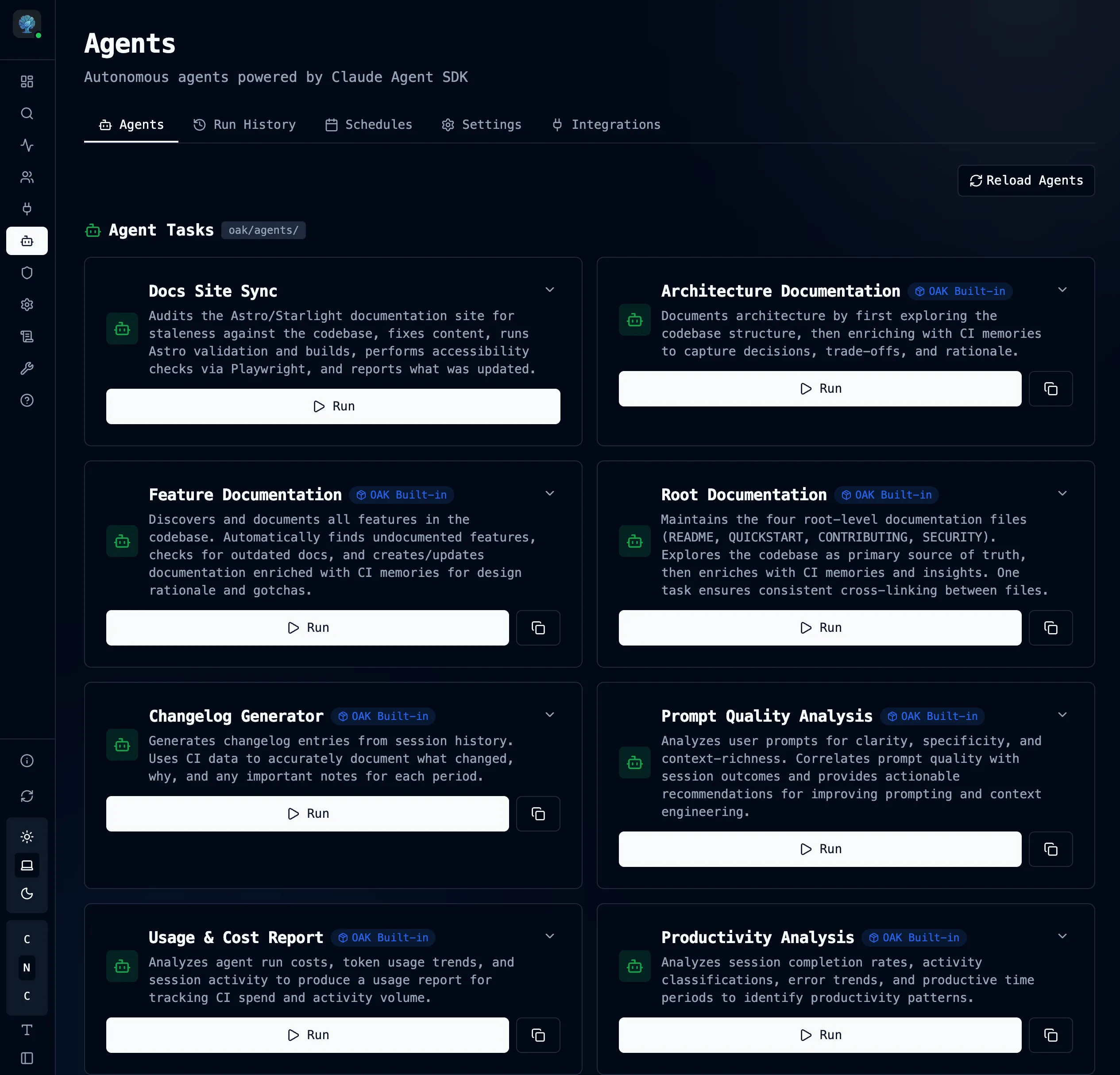
| Agent | Purpose | Built-in Tasks |
|---|---|---|
| Documentation Agent | Maintains project documentation using the full CI knowledge base | Root Documentation, Feature Docs, Changelog, Architecture Docs |
| Analysis Agent | Turns CI data into actionable insights about productivity, costs, and codebase health | Usage & Cost Report, Productivity Analysis, Codebase Activity, Prompt Quality |
| Engineering Agent | An engineering team with role-based tasks for code review, implementation, and issue triage | Senior Engineer, Product Manager |
| Maintenance Agent | Keeps OAK’s memory store healthy — consolidates duplicates, resolves stale observations, and maintains data hygiene | Memory Consolidation, Data Hygiene |
Interactive Editor Agent (ACP)
Section titled “Interactive Editor Agent (ACP)”The Agent Client Protocol (ACP) integration lets ACP-compatible editors like Zed connect to OAK directly, turning it into your interactive coding agent with team intelligence built into every response.
Each agent template above is available as a focus you can switch to mid-session — the focus determines which system prompt, tools, and CI access the agent uses, while preserving your conversation history.
| Focus | Agent Template |
|---|---|
| Oak (default) | Interactive coding with full CI context |
| Documentation | Documentation Agent |
| Analysis | Analysis Agent |
| Engineering | Engineering Agent |
| Maintenance | Maintenance Agent |
See Agent Client Protocol (ACP) for editor setup, session modes, and how to switch focus.
Provider Configuration
Section titled “Provider Configuration”OAK Agents use the LLM provider configured in the Agents page → Settings tab (/agents/settings). This is separate from the summarization model — you may want a more capable model for agent tasks.
Supported providers:
| Provider | Type | Notes |
|---|---|---|
| Claude Code (Default) | Cloud | Uses your logged-in Claude Code subscription on this machine (no API key needed). |
| Ollama | Local | Experimental for agent execution. Requires v0.14.0+ and a capable local model. |
| LM Studio | Local | Experimental for agent execution via local OpenAI-compatible endpoint. |
Test the connection from the Agents Settings tab before running agents.